Wednesday, December 21, 2011

Pumpkin Pączki (Doughnuts) ‏באַניע ‏פּאָנטשקעס


Pumpkin Doughnuts

Sift together:
4 1/2 cups (18 ounces) flour
1 tablespoon baking powder
1/2 teaspoon baking soda
1/2 teaspoon salt

Blend:
1/2 cup buttermilk
3/4 cup cooked, mashed pumpkin or winter squash
1/2 cup (1/4 pound) melted butter
1 cup (1/2 pound) brown sugar
1 1/2 teaspoons vanilla
zest of one lemon
12 scrapings (1/4 teaspoon) nutmeg
3 eggs

Mix the pumpkin mixture into the flour to make a soft dough. Roll the dough out half an inch thick. Try to the extent possible to roll the dough evenly so that the doughnuts will fry evenly. Cut the doughnuts using a large cutter and make holes with a smaller cutter. I believe they actually make doughnut cutter to save you the labor of making two cuts, but I have never felt the need for one.

Heat about three cups of coconut oil (or other oil) in a cast iron dutch oven or other wide, shallow pot. Fry the doughnuts a few minutes on each side until golden brown. Drain on brown paper or paper towels and dust with powdered sugar.

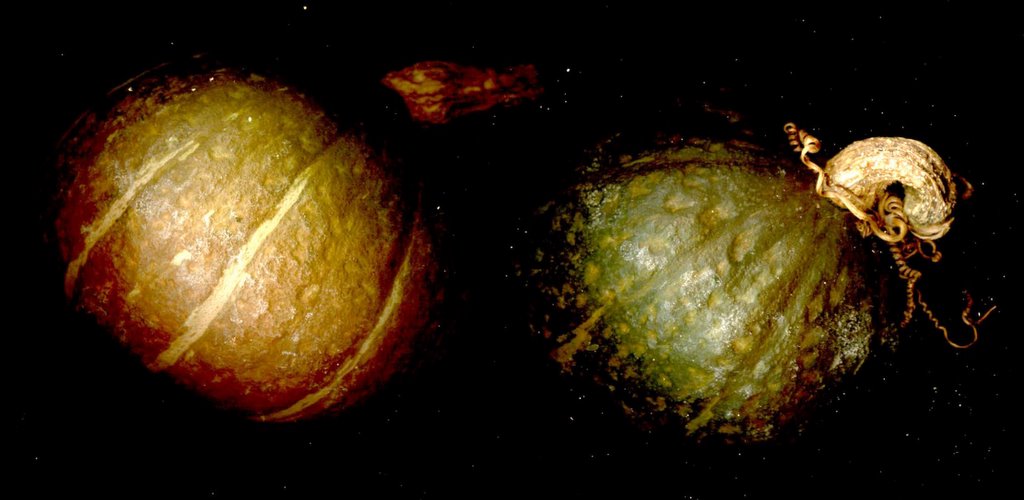
I made these donuts with the most beautiful  pumpkin in the world, this Tonda Padana Pumpkin from Maxwell Farm.   The Elizabeth Taylor of squash.


אַ משל פֿאַר די חנוכּה לעמפּלעך
A moshl far di khanike lemplekh
"An example (or a parable) for the Chanukah menorahs"
That is, an example which is utterly irrelevant and in no way advances your argument

דער חנוכּה לאָמפּ
der khanike lomp the Chanukah menorah

באַניע
banye pumpkin

דאָס חנוכּה ליכטעלע
dos khanike likhtele Chanukah candle

לאַטקעס
latkes latkes

פּאָנטשקעס ‏
pontshkes doughnuts

חנוכּה קעז
khanike kez Chanukah cheese
(I have seen a couple of references to something called khanike cheese, but I have no idea what it is. Anyone familiar with this?)

Since we filmed this episode, I have started frying the doughnuts in coconut oil.


Labels: ,

Monday, November 12, 2007

Musquee de Provence: The Prettiest Pumpkin

What exquisitely defined lobes! The musquee de Provence is a very pretty pumpkin on the outside but nothing prepared me for this:

Wow, I don’t think I have ever seen this color on anything before. The cooked flesh separates into strands like spaghetti squash and is richly flavored with hints of tangerine and pistachio. The texture and juiciness make this an ideal pumpkin for stuffing. And so easy on the eyes. This just might be the Julia Roberts of Squash.

Musquee de Provence Pumpkin for Stuffing

Scrub your pumpkin all over and put it into an appropriately-sized ovenproof dish. Place the dish on a sheet pan in case of any irrational exuberance, and put the pumpkin in the oven. Bake at 375 for about an hour and a half, depending on the size of your pumpkin (this one was 14 pounds). Remove the pumpkin from the oven, and when it is cool enough to handle, cut out a lid. Pour out any fluid that may have accumulated during baking and scoop out the seeds and inner fibers. Salt the inside of the shell and the lid, and fill the stuffing or dressing of your choice, like herbed hominy stuffing, or coconut cornbread stuffing. This time I made chestnut stuffing, to be posted very soon, no solemn vow implied. Spoon the filling in gently, and resist valiantly the impulse to tamp it down. You can bake the remaining out-of-pumpkin stuffing on its own. Return the stuffed pumpkin to the oven and bake another hour or so.


The vibrant color of this pumpkin indicate a rich store of carotene and anthocyanin. Sweetnicks will provide links to more of these life-giving antioxidants.
Food and Drink, Recipes, Cooking, Food, Vegetarian, vegan, vegetables, antioxidant-rich foods, , ,

Labels: , ,

Thursday, October 25, 2007

Acorn Squash, Just So

I made baked acorn squash recently, and enjoyed than more than I thought I might. Sugary sweet and conventionally pretty, this Ann Sheridan of squashes has never been in the first tier of my favorites and I wouldn’t normally pick it out for myself, but these acorn squashes came from my CSA and of course they are to ordinary acorn squash as the apple tree to the trees of the wood. I just baked them cut side down for about thrity minutes, and then flipped them over to add butter, salt and pepper. There is really nothing else you need to add.

Labels: ,

Tuesday, October 23, 2007

Uchiki Kuri Squash Soup with Lentils

Holy cow! I like winter squash, in fact I like winter squash a whole lot, but I have never before been the least bit tempted to try it raw. Just before I left I got this smashing uchiki kuri squash from my CSA. As soon as I cut it open the fresh, sweet, fruity, and completely irresistible smell filled the kitchen and I just had to slice off a bit and have a bite. The dense flesh is juicy and sweet. I cooked them anyway, but these kuris present a whole new level of squash possibility, clear, pure, and beautiful. This Beverly Sills of squash will make you smile from ear to ear and fill your heart with sunshine.

Sometimes these are orange all over, but look at those snazzy green speckles! The skin is tender, so you don’t need to peel them.

Late October Lentil Soup with Uchiki Kuri Squash

1 dense-fleshed squash such as uchiki kuri or kabocha, about 1 ½ pounds after trimming

3 cups lentils

olive oil

3 medium or largish onions, diced

1 tablespoon whole cumin seeds

several stalks of celery, peeled, destringified, and sliced (just one stalk is fine. So is a whole bunch)

salt and pepper

leaves from one bunch of parsley, chopped

parmesan rinds, if you happen to have some

lemon wedges, ditto

Cut the squash open and remove the seeds and fibers. Cut the flesh into cubes or oblate parallelepipeds that will fit comfortably in a spoon, and set aside. Wash and pick over the lentils. If you like, you can let them soak a bit while preparing the vegetables. Heat oil in a soup kettle and add the diced onions and cumin seeds. Stir and cook until the onions are relaxed and add the celery. Add the drained lentils and about three quarts of water. Bring to the boil and then lower the heat and simmer for thirty minutes. Add the squash, parsley, and parmesan rinds if you are using them. Cook for another half hour or until the squash is quite tender. Season to taste with salt and pepper. You may serve this soup with parmesan, or lemon wedges, or both, and it is just right on its own.

See Nami Nami, where Pille will be rounding up this Weekend's Herb Blogging creations.

, , , , , ,

Labels: , ,

Friday, October 12, 2007

Bumpy Pumpkins of Provence


You have, it seems to me, two choices. You can buy a couple of pounds of peanuts and glue them to the surface of your pumpkin, or you can skip the middleman by getting a Poitron Brodé Galeux d’Eysine.

I am told that this lovely but unconventional surface goes along with a surprisingly powerful flavor. This must be the Ida Lupino of Squash.

Labels: , ,

Tuesday, January 17, 2006

Lentil Soup with Kabocha and Cumin


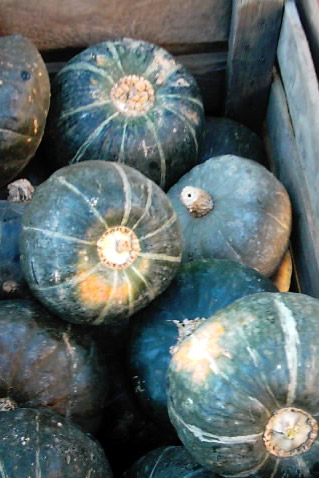
These gorgeous kabochas are from Race Farm, at Union Square on Mondays. These kabochas are just getting better and better as the winter progresses. They are some of the loveliest most satiny and intensely flavored squash I have ever tasted. Thank you Race Farm!

Thanks as well are due Sweetnicks, who has valiantly begun collecting blog-posts that employ “ARFs” or Antioxidant rich foods. Thank you Sweetnicks!

While I was waiting to buy my squash I had the following conversation with a family browsing among the vegetables:

Wee Bairn: What’s that enormous thing?
Doting Maternal Unit: I don’t know.
Chocolate Lady: That’s a hubbard squash!
Doting Maternal Unit: Oh, is that a hubbard?
Chocolate Lady: Yes! It’s the Bette Davis of Squash.
Wee Bairn: I hate squash.
Doting Maternal Unit: No you don’t.
Chocolate Lady: Even the kabochas?
Wee Bairn: Well, maybe not the kabochas.

Mr. Chocolate Lady is deeply fond of lentils, so I am often trying to make up new lentil soups. Kabochas and lentils are an especially felicitous pairing, with the sweetness and softness of the squash complementing the austerity lentils. Cumin brings the soup together. This soup is almost effortless to prepare. Once again, I made a big pot of soup, but you can probably halve this recipe with no ill effects.

Lentil Soup with Kabocha and Cumin

Olive oil
2 large or three medium onions
Two teaspoons whole cumin seeds
Seven large celery ribs: About half of one head of celery—2 or 2 ½ cups sliced
5 cloves garlic, sliced (not diced or minced)
2 cups plain brown lentils
One medium kabocha about 1 ½ pounds
12 or so sprigs flat leaf parsley (half of one bunch) minced

Dice the onions. Heat olive oil in a large soup kettle. Add the diced onions and whole cumin seeds. Cook until the onions are quite soft, about 15 minutes. De-stringify the celery and either dice them or slice into little moons. Add celery and sliced garlic to the pot with the onions and continue cooking for another fifteen minutes or so. Meanwhile, pick over and rinse the lentils and cut the kabocha into medium dice that will be small enough to fit comfortably in a soupspoon but large enough to show off the vivid colors. Add squash and lentils to the soup pot along with about three quarts of water and a tablespoon of salt. Raise heat and bring to the boil. Reduce heat, de-scum, and simmer for about 45 minutes, or until the squash and lentils are tender. Add minced parsley and taste for seasonings. A squeeze of lemon juice is sometimes nice with this.

Labels:

Wednesday, December 28, 2005

Turnips


Above, a white turnip from John Madura Farms, and a Robertson’s golden ball turnip, probably the finest culinary turnip (not a rutabaga!) from Keith’s Farm, both represented at Union Square on Wednesdays. At first I thought this kind of turnip was called “goldenbor” and thought it might have something to do with winterbor kale and redbor kale.

The Yiddish word for turnip is di brukve, and rutabaga is di shvedishe brukve. A Brussels sprout is di brukselke or der briseler kroyt.

The estimable Language Hat posted about rutabagas in language and literature about a month ago, and ever since I have been wanting to root up something Yiddish about rutabagas or turnips. Somehow, I can’t think of anything, but I always felt that I remember Marlene Dietrich’s movies and music as having been in Yiddish. Does anyone else get that? Here is the entry on turnips from Marlene Dietrich’s ABC, a memoir in lexicon form by the screen goddess and serial autobiographer:

TURNIPS
I was raised almost entirely on turnips and potatoes, but I think that the turnips have more to do with the effect than the potatoes.
(See POTATOES)


Saturday evening’s In Mol Araan was devoted to bagels in the life and work of the Ba’al Shem Tov. I would not have guessed I would ever need to blog twice about the Besht and Jewish food in one week, but az me lebt, derlebt men (very roughly: live and learn). This very puzzling tale is related in Shivkhey haBesht (from Dan Ben-Amos and Jerome R. Mintz’s 1970 English translation).

189. The Turnip
I heard that once they put a turnip on the Besht’s table, but he refused to eat it. They asked him why, and he said “This turnip grew in a gentile cemetery.” They did not want to eat it either and they put it at the end of the table.

This story is less about the turnip than about the Besht’s uncanny ability to discern the turnip’s provenance. At least, I think that’s what it is about. These are some very confusing stories. The turnip story from the Grimms is even more disturbing.

Here’s some turnip bibliography. I like the title Those Brassy Brassicas.

These turnips are probably going into a lentil soup this week. I have these very pretty brown lentils, smaller than common lentils, but bigger than French lentils or black beluga lentils.

, , , , , , ,

Dietrich, Marlene. Marlene Dietrich's Abc. Garden City, N.Y.: Doubleday, 1962.

Dov Baer ben, Samuel, Dan Ben-Amos, and Jerome R. Mintz. In Praise of the Baal Shem Tov [Shivhei Ha-Besht]; the Earliest Collection of Legends About the Founder of Hasidism. Bloomington: Indiana University Press, 1970.

Labels: ,

Tuesday, December 06, 2005

Lost and Found Kabocha Soup of Many Colors


I am very excited about the buttercup family of squashes, and especially the kabocha. Finely-grained, densely-textured, utterly without stringiness, it is the Greta Garbo of squash. Their dark green outer shells make you think that they are grim and austere, but the skin is soft and edible, and contrasts beautifully with the feverishly orange pulp.

I just made this soup again for the first time in several years. Every written or emailed version had vanished without a trace, but I was finally able to reconstruct the recipe. This may well be my most beloved soup of all, and I do like soup. This recipe makes lots of soup, but you can halve it by using half a squash, or a smaller squash.

Lost and Found Kabocha Soup of Many Colors

1 kabocha, buttercup, or Hokkaido squash, about 2 pounds
3 medium onions
3-6 red peppers (about 2 pounds)
5 celery ribs
olive oil (be lavish)
5-7 very small garlic cloves, if you have some
1 whole fresh red chile
5-7 medium to large cloves of garlic (more if you didn’t have the tiny ones)
1 small bunch arugola
1 small bunch parsley
1 small bunch dill

Cut the squash into dice of a size the will nicely show off the contrast between the dark green skin and bright orange flesh, but small enough to fit in a soup spoon. Slice the onions into very thin half moons along the longitudinal lines. Peel the peppers and slice into thin julienne. Peel and de-stringify the celery and cut into medium dice.

Cover the bottom of a large soup pot with olive oil and warm over low heat. Add the sliced onions and stir and cook 15 minutes or until onions are soft and transparent. Add the celery, red peppers, the chile, and tiny whole cloves of garlic and continue cooking ten minutes more. Slice the remaining garlic into thin slices and add to the pot and continue cooking until fragrant. Add the squash and about three or four quarts of water, so that there is an equal volume of water and vegetables. Raise the heat and bring the soup to the boil. Lower the heat to the simmer and cook until squash is tender, periodically skimming the surface. Taste and season with salt and freshly ground black pepper. At the end add coarsely chopped arugola, minced parsley, and snipped dill.

Labels: ,

Tuesday, November 15, 2005

Jarrahdale pumpkin


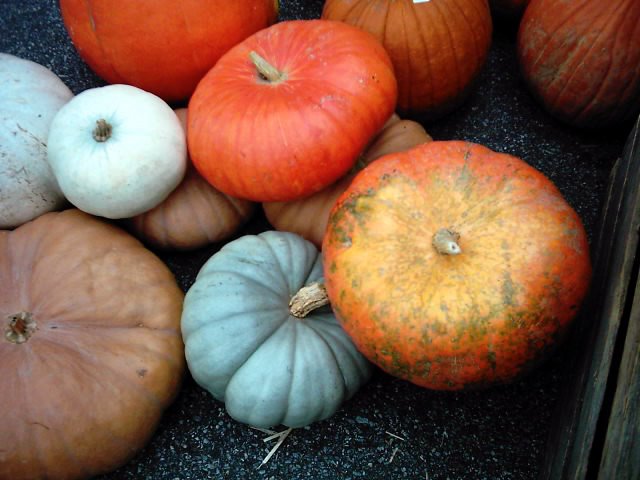
Please meet some of the pumpkins and squashes from Maxwell Farm, at Union Square New York on Mondays. The blue lobed pumpkin in the center is the one I took home. According Elizabeth Schneider’s vegetable book, this is a Jarrahdale Pumpkin (Cucurbita maxima, hundert-funtike dinye). This variety has the purest deepest clearest flavor of any of the pumpkins. It seems so mild, but steely strength is wrapped up in its purity and clarity. It is the Lillian Gish of pumpkins.
Almost all recipes will tell you to cut open the pumpkin and scoop out the seeds and fibers before baking. I find that it is easier for me to put the whole pumpkin in the oven in a pyrex pie plate of a suitable diameter and then eviscerate the pumpkin when it is nice and soft. The only thing you need to watch is that the whole pumpkin will exude lots of water while baking, so you need to tip the dish and drain it out once or twice during baking. This is still easier than breaking into a honking great pumpkin.
You can use the baked and drained pulp for pies, pumpkin cheesecake (recipe coming soon), or The Chocolate Lady’s gorgeous pumpkin challah, but this pumpkin is so pretty that I like even more to keep it whole and fill it with my grandmother’s cornflake stuffing and braised wild rice tempeh. Here's the challah recipe for now:
Pumpkin Koyletsh or Khale (Challah)
(yummy, meltingly toothsome, yellow as yellow can be)
½ cup water
3 packages yeast
1 cup Jarrahdale pumpkin pulp (or cheese pumpkin or butternut squash pulp)
1/4 cup olive oil or other oil
1 ½ eggs
4 yolks
1 tablespoon salt
¼ cup honey
6 cups bread flour
½ egg
1 teaspoon water
poppy seeds (or sesame, maybe a few pumpkin seeds)
Sprinkle yeast over warm water in mixing bowl and allow to proof. Add oil, salt, sugar, pumpkin and eggs and mix well. Add the flour and mix and knead until a stiff dough forms. Set aside and allow to raise in an oiled bowl about one hour or until doubled in size. Divide into twelve pieces and roll each piece into a smooth seamless sphere. Roll each dough lump slightly to elongate. Go back to dough lump number one and roll each one a little more. Continue until you have twelve ropes about 12-15 inches long. Braid into two khales of six strands each.. To braid six strands, fasten them at the top, then move the leftmost rope to the center, and the rightmost but one to the left. Then move the rightmost to the center, and the leftmost but one to the right. Continue to the bottom and pinch the ends together.
Allow the khales to rest 40 minutes or so. Preheat oven to 400 degrees. Brush with remaining half egg beaten with a teaspoon of water and sprinkle with seeds. Bake for 30 minutes or until brown.
This recipe, along with some wonderful pictures, appears in Yiddish here.
Bonus Lillian Gish trivia: “Lillian Gish” is Cockney rhyming slang for “fish” See the Cockney Bible eg: “They told 'im, ‘We've got five loaves of Uncle Fred and two Lillian Gish’.”
Have a shifty at pictures of some squash varieties.

Schneider, Elizabeth. Vegetables from Amaranth to Zucchini : The Essential Reference : 500 Recipes and 275 Photographs. 1st ed. New York: Morrow, 2001.

Labels: , , ,