Sunday, May 05, 2024

Vegan Pistachio Macaroons


Vegan Pistachio Chia Macaroons

1 ounce pistachio pulp (leftover from two batches of pistachio ice cream)

1 ounce sugar

2 tablespoons chia porridge (recipe below)

granulated sugar 

Dry out pistachio pulp in a cool oven (you can probably use ground pistachios and scale up the recipe if you 

A did not just make two batches of vegan pistachio ice cream, and 

B would like more than six cookies).

Heat the oven to 325

Pulverize the dried pistachio pulp with sugar  and mix in enough chia porridge to form a stiff dough. Form the dough into walnut-sized spheres and roll the spheres in additional granulated sugar if desired. This will yield 6 macaroons.


Bake the macaroons for 25 minutes or until lightly browned.


Chia Seed Porridge


1/2 cup chia seeds

3 cups water

cook the chia seeds in water for about 15 minutes.

Labels: , , ,

Friday, April 15, 2022

Cassavekoek A Passover Cake from Suriname


I am very excited to be trying this recipe, for which I am grateful to my brilliant colleague Eli Rosenblatt.


The word "cocosnoot" will never cease to delight me


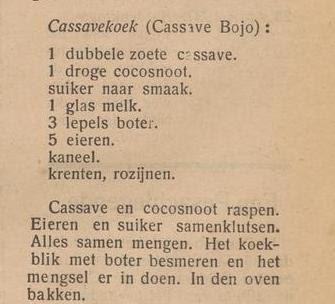
 The recipe comes from “Teroenga” April 1942, the Jewish journal of Paramaribo Suriname.  While I have been arguing for years that cassava (yuca, manioc) is perfect for peysekh, I have not come up with any recipes other than yucas fritas.  This year I am making at least two yuca-centric preparations, this cake, and a vegan sancocho for a  Seder Caribeño or Caribische Seder .


If you have time, Prepare the cassava a day ahead so you can freeze the grated cassava overnight and thaw it out before baking.  Remember to thaw the cassava.  I almost skipped this step.

Cassavekoek (Cassava Bojo)

1 Cassava (about 1 pound to yield about 2 1/2 cups pulp)

1 ripe coconut

1 cup milk

8 ounces ( 1 cup) dark brown sugar (or any sugar, more or less, to your taste)

2 ounces (4 tablespoons, 1/4 cup) butter

5 eggs

1/8 teaspoon cinnamon (I had no cinnamon this time, but 1/8 teaspoon would be good)

6 ounces (1 cup) raisins, soaked in 1/4 cup slivovitz, if desired

butter for the pan 

Heat the oven to 350F /180C, and butter a nine-inch cake or pie pan, and six muffin cups or a nine by thirteen pan.

Peel the cassava. You will need a sharp knife because the skin is tough and probably coated with wax. Cut the cassava lengthwise and remove the woody core. 

Grate the pulp or grind it up in a processor. If you have time, freeze the pulp (remmeber to thaw before baking).


Pierce the coconut and drain the water.  Bake for about 20 minutes. Smash open, and pry out the pulp.  You need not peel off the brown membrane for this cake. Grate the coconut pulp or grind it in a processor.  While the processor is running add the milk (water would probably be fine).


Melt the butter over low heat, and continue cooking a few minutes until it becomes deep brown and smells like the best bakery.

Beat the eggs, beat in the sugar, and drizzle in the brown butter. Fold in the coconut and cassava and the raisins. Scrape the batter into the prepared pans.  Bake for forty minutes until the surface is golden and a knife emerges clean


 Some notes on the original recipe and my adaptations

1. I do not know any Dutch

2. The recipe calls for a sweet cassava.  Fortunately, all the cassava available in the United States is sweet cassava.

3. I browned the butter, because brown butter.

4. Yes, even without knowing Dutch, I can sort of see that the original recipe calls for only three spoons of sugar, but I just have a strong feeling that they are large English-style dessert spoons, about four teaspoons 1 1/3 tablespoon each. Maybe even larger.

5. Traditionally you might soak the raisins in rum, rather than Slivovitz

6. This might be prettier in a cake pan, but one leniency I allow myself is to make all Peysekh cake in aluminum pie pans.

Labels: ,

Tuesday, April 14, 2020

The Chocolate Lady’s 2020 Vegetarian Peysekh Survival Guide


"Preparedness" A common theme in the Yiddish press in 1916.  Frequently Uncle Sam and doughboys are seen taking up arms against the enemy.  Here Jewish women and girls arm themselves against khomets.

Oh, my beautiful ones, how do I even send a document with the word "survival" in it? Survive.  Make whatever you want.  When I started this guide in 1995, it was my intention to share ideas for meals my friends would be able to make easily with minimal ingredients and equipment, but somehow over the intervening years, as my experience and batterie de cuisine have grown, it got to the point where I was telling you to make corn-free cornflakes with plantain flour. Now folks who have never baked a potato find themselves staring into the bumpy, russet abyss.  Take my hand.

How to Bake a Potato

Potatoes

Scrub potatoes thoroughly.  If you wish, you may coat them lightly with butter or oil.  Place in an oven heated to 450F.  If you have something in the oven baking at 400F or even 350F that is fine.   Bake for an hour or slightly longer.
You need not pierce the potato, and you may not wrap it in aluminum foil (all right, just this year, because of extraordinary  circumstances I will allow you to wrap your potatoes, I will even allow you not to peel your asparagus, just don't get used to it). 


Here is my recipe for Unplugged Ajvar, and links to sixteen fabulous recipe videos.
Here is the delicious Melitsana Matzo Pita that has been the star of the final nights of Peysekh Chez Chocolat for many years.

Here in the most wonderful vegan spinach thing ever.


Some valuable paraliturgy has emerged.  I have found these helpful.

Tkhine for a plague from 1916

Prayer to stop the plague in Bombay 1896. Deliverance was brought by Dr. Waldemar Mordecai Hafkine.

Minimalist guide to Passover  

Labels: ,

Friday, March 20, 2020

Eggplant Matzo Pie מצה־געבעקס מיט פּאַטלעזשאַנעס μελιτζάνα-μαζω πίτα


שוין 15 יאָר מאַך איך דעם מצה־געבעקס אַלע פּסח.  ער לענט זיך אונטער דאָס האַרץ  


מצה געבעקס מיט פּאַטלעזשאַנעס

2 גרויסע פּאַטלעזשאַנעס
2 מצות
2 אײער
¼ טעפּל זונרויז־סעמישקע בוימל
8 אָנצן פֿעטאַ
8 אָנצן קאַסערי, אָדער קאַשקאַװאַל, אָדער עמאָנטאַל
זאַלץ, פֿעפֿער, און פּאַפּריקע לויט ענקער געשמאַק


בראָט אָפּ די פּאַטלעזשאַנעס אין בראָטאויװן אָדער אויף אַן אָפֿענעם פֿלאַם.  װענ זײ װערן קיל גענוג, שײלט זײ אָפּ. צעהאַקט זײ אויף פּיצלעך.  
װײקט אײַן די מצות אין װאַסער זײ זאָלן װערן װײך און קװעטשט אויס דאָס װאַסער.
מישט אויס צעהאַקטע פּאַטלעזשאַנעס, מצות, אײער, פֿעטאַ, און אַ ביסל בוימל און קאַסערי.  גיט צו זאַלץ, פֿעפֿער, און פּאַפּריקע לויט ענקער געשמאַק. 

לײגט אַרײַן אין אַ בעקעלע און באַשיט מיט דער איבערגעבליבענער קעז און באַגיסט מיט בוימל.  באַקט אָפּ אויף 350 אַ 40 מינוט


I have been making this every Peysekh for about 15 years.  It is very warming and comforting

μελιτζάνα-μαζω πίτα  
Eggplant Matzo Pie

2 large eggplants
2 matzos
2 eggs
1/4 cup olive oil
8 generous ounces feta
8 scant ounces kasseri, or kashkaval, or emmenthal, or something melty.
salt, pepper, and paprika to taste

Broil the eggplants under the broiler or roast them over the fire.  If you have a grilling chimney set-up or something like that, even better.  
Soak the matzos in warm water until quite soft.  Drain the matzos and squeeze out the water.  
When the eggplants are cook enough to handle, peel off the charred skin with you immaculately clean fingers.  Chop the pulp.
Combine crumbled matzos, chopped eggplant, crumbled feta, two beaten eggs, and most of the oil and kasseri.  Add salt, pepper, and paprika to taste.
Transfer to an oiled baking dish and sprinkle remaining cheese on top.  Drizzle with remaining oil.
Bake at 350F for about 40 minutes, or until top is crisp and golden.


זיך אונטערלענען דאָס האַרץ
to be warming and comforting

דער פּאַטלעזשאַנ(עס)
eggplant

אָפּבראָטן
to broil

אײַנװײקן
to soak

אָט האָט עט'ץ צװײ פּרימיטיװע פֿילמען פֿונעם רעצעפּט
Here are two primitive videos of the recipe.

Labels: , ,

Wednesday, April 04, 2018

Breakfast Flakes for Peysekh (Passover Cereal)


If I give you twenty guesses, I bet you can't guess what I am cooking right now, or maybe you can, because you read the headline.  This recipe is for The Glaistig, who is cereal-dependent throughout the year and cereal-deprived during Peysekh. 
This recipe is also for anyone else who needs a convenient wheat-free, gluten-free, gebrokhts-free cereal.  By convenient, I mean convenient to eat once someone has made them. 
And of course, this recipe is for anyone else, who, like me, enthusiastically bought bags of almond flour and plantain flour last week and has no idea what to do with them.
 
I found this page of recipes for homemade cereals intriguing and made a variation on the corn flakes.  Allow me to note that this page also links to a recipe for homemade Cheerios, which involves shaping each individual Cheerio (does anyone use Cheerio in the singular?) by hand and making a little hole with a toothpick.  I want to make fun of this recipe, but I am all too afraid I will then wake up with an irresistible compulsion to make my own cheerios.  You know what happened with the rejuvelac and cashew cheese, don't you?

Plantain Almond Flakes
 
2 scant tablespoons plantain flour
2 generous tablespoons almond flour
1 or 2 pinches salt
1 to 4 pinches sugar

Mix together the flours and seasonings with your fingers.  Sprinkle about one tablespoon the mixture onto the bottom of a non-stick or cast iron skillet.  There should be barely enough to cover the bottom. Wet your fingers and shake water over the surface of the flour so that it is evenly soaked but not disturbed.  A spray bottle might make this easier.  Heat the mixture so that it dries out and begins to toast.  Flip over to break up and toast on the other side.  Allow the skillet skillet to cool before starting the next batch.

Labels: , , , ,

Monday, March 29, 2010

The Chocolate Lady's 2010 Vegetarian Peysekh Survival Guide


The Chocolate Lady's 2010 Vegetarian Peysekh Survival Guide


Last year, a neighbor was telling me about the seder meal he was planning to cook for his sons, and he mentioned brisket. I was flooded with aching nostalgia, even though I have never had brisket and am not even entirely sure what it is. Somehow the sensations and yearnings were nevertheless utterly real and immediate. Then the next night I was at a seder, and I realized, well, of course, this is exactly what we do on Passover. We “remember” an event we never experienced, but our memories, rehearsed every year, are honed to an exquisitely fine edge.

It is a time of great excitement, but also no small bemusement. It was for this reason that I made the first Peysekh survival guide in 1995. Some elements have dropped out (I decided I was just not in the mood for spice-crusted potatoes during Passover) and others, such as the asparagus peeler, have been in every issue. Have a look at soup and cookies from last year, the abbreviated guides from 2008 and 2007 and the comprehensive 2006 edition

Ingredients

Stocking up: While it is true that I rely on eggs and milkhiks at Peysekh, I insist that it is possible to be a vegan at peysekh as well. I even insist that you can do it without potatoes. This year I am again expanding a special section of vegan, nightshade-free peysekh choices.

Coconut

Coconut has become more important to my peysekh cooking (and all my other cooking) every year. What a miraculous comestible a coconut is! Many folks with allergies to most other nuts can safely eat coconut (but always check to make sure who can eat what safely). Up until last year I had been purchasing shredded coconut in those little six ounce packages, but I promised that this year I would smash open and grate my own coconut. As Tu B’shvat approached, I realized that I had better start practicing, just so that I would not end up banging coconuts against my skull on erev peysekh. Fortunately, the extraordinary Indira provides reassuringly clear and thorough instructions for coconut shkhite and milk extraction.

I was grateful this year for Jihva for coconut , a round-up of luxurious Indian coconut recipes, many of which are suitable for peysekh. This Coconut milk Stew with Potatoes looks like just the very thing.

Chocolate

I use Schmerling’s bittersweet chocolate (also called Maestrani chocolate) for Peysekh. Last year I also picked up some of their new 72% chocolate. The 72% chocolate is very nich for eating out of hand, but I recommend the regular bittersweet for recipes such as chocolate mousse and chocolate coconut cake.

Celery

Essential for soups. Tonic in any quantity. And then there’s this:

If you were to stand on a hill during any Sunday afternoon in winter and listen carefully you would hear a low, rustling, crunching sound. It is the entire English nation, eating celery.

--Adrian Bailey, quoting his father in The Cooking of the British Isles Artichokes

Marlene Dietrich was a great believer in the tonic properties of artichokes. I love artichokes. Artichokes are appearing at this time of year and are suited to many Passover preparations, but most appealing to me is the way the ceremonial is recapitulated in the culinary with the toyvling of each leaf.

Asparagus

During peysekh you are using much less kitchen equipment that usual, and

probably finding that you can do more than you thought, but one thing you do

need is an asparagus peeler. This is a ‘V’ shaped peeler that cradles the

spear to peel without snapping. Peel your asparagus. Life is good.

Plantain

Available green, yellow-brown, or black, these banana-like fruitoid things actually turn out to be a pretty decent and very nourishing potato-substitute for those on a nightshade-free diet. Use the green ones to grate for latkes (or combine them with grated taro, see below) and bake or boil the riper yellow or black ones. The peels do not slip off as easily as banana peels, so be prepared to use a knife.\

Plantain chips

Last year I found this wonderful recipe for plantain chips on Indira’s breathtaking blog Mahanandi. Two details in particular captured my interest. The first is that you scrape off the outer peel, but leave the inner peel on to make the chips—sounds just right. The second is that in Kerala, plantain chips are fried in coconut oil. If there is anything more orchidaceous than plantain chips, it is plantain chips fried in coconut oil. I don’t know if anyone makes klp coconut oil, though.

Cookbooks

Balkan eggs

Hot peppery eggs with cold garlicky yogurt.

Eggs Panagyurishte Style

2 eggs

2 teaspoons oil

1 cup yogurt

2 to 3 garlic cloves

½ teaspoon sweet Hungarian paprika

Fry eggs in oil sunny side up. Drain on paper towel and transfer to a plate filled with yogurt. Add paprika to the remaining hot oil, quickly stir, and then dribble a little over the eggs for color. Serves 1

The garlic can either be crushed into the yogurt or served on the side. This dish can also be made with poached eggs.

From Bulgarian Rhapsody by Linda Joyce Forristal, Bladensburg MD: Sunrise Pine Press, 1998.


The Book of Jewish Food by Claudia Roden

Last year I made a wonderful orange cake recipe from this book. It falls into a particular subgenre of recipes for which I have a special affection. These are the recipes that employ techniques so utterly different from those with which I am familiar, that I am sure they must be the result of typographical errors. In this particular recipe, you take two oranges, and you put them on a pot of boiling water, and you boil them for over an hour and a half. You don’t peel them or cut them or anything. Just throw two big old whole oranges in the boiling water. Damned if it doesn’t work! Then, when the oranges are quite soft, remove the seeds, mash or purée them, and mix them with ground almonds beaten eggs and sugar, and bake in a moderate oven. This is very easy and makes a lovely cake. See Roden’s book for this recipe and several other wonderful peysekh cakes


The Unplugged Kitchen by Viana La Place

I am afraid I am going to have to insist that you buy this book. When I first read it, I was so impressed that I went around for weeks accosting perfect strangers on the street to tell them they needed The Unplugged Kitchen. I was nearly arrested on two occasions. This should begin to give you some idea of what a valuable outlet blogging has been for me.

La Place’s recipes are exquisite and many are particularly suited to Peysekh, even though it is not specifically a Peysekh cookbook. TUK is devoted to recipes that can be made by hand, which I also find especially helpful during Peysekh, when I am working with a much more limited batterie de cuisine. Try the layered saffron potatoes on page 222 (oh, this is so good), the artichokes and potatoes on pages 199 and 201 and the wonderful Persian herb pie on page 83. The celery stew with almonds is also lovely and it is a good austere dish to make when you are recovering from lots of festive food. This year I might try the romaine soup, without the bread of course, the beet and lemon broth, and maybe the beet and pepper salad.

While I am on the subject, I also recommend all of La Place’s books. Verdura is sensuous and thrilling, and Cucina Fresca, written with Evan Kleinman, is a collection of dishes that can be prepared in advance and served at room temperature, which is very helpful for shabes and sikes.

Bitter Almonds by Maria Grammatico and Mary Taylor Simeti

You wouldn’t guess that a book about growing up in a convent would turn out to be such an important Passover resource, but many of the pastries herein are based on almond dough and ideal for peysekh. A few years ago I made the dolcetti al liquore, spirit-soaked grapes in marzipan tartlets dipped in dark chocolate. Bitter Almonds also has a few recipes that use citron (esrik) preserves, for which a recipe is also provided, making it handy for sikes as well.

And of course, you will be wanting to make a tsimes.


FAQs


In the mousse recipe, you add water to melting chocolate. How do you prevent the chocolate from seizing up?

While it is true that if you add a tiny drop of water to melting chocolate, it will seize up and become entirely useless, it is in fact the case that if you add a larger amount of water to melting chocolate everything melts together just beautifully, so the substance that is disastrous in small quantities is no problem if you just pour it in. This must be a metaphor for something in Jewish history. Any ideas?

I see you mention parsnip and parsley root. Are they not the same thing?

A parsnip, PASTINACA sativa (Yiddish pasternak, פּאַסטערנאַק), resembles its relative the carrot, but has pale yellow flesh and a stronger, sweet flavor. Parsnips remain famously unbuttered by faire words. A parsley root, PETROSELINUM radicosum (Yiddish petrishkeפּעטרישקע ), is whiter and has a more herbaceous mineral flavor.

You don’t really carry all your peysekh shopping back from Brooklyn on your bicycle, do you?

Indeed I do.

What, in the long skirt and everything?

And everything, yes.

What does that sign on the Williamsburg Bridge mean?

For most of this winter and early spring, a sign on the Williamsburg Bridge advised cyclists to stay “visable.” I can only assume that this means one now needs a passport with a valid visa to get into Brooklyn. Fortunately for the city’s peysekh shoppers, the sign was removed shortly after Purim.

Why no peeking at the matzo balls?

They will deflate if disturbed.

I see that your matzo ball recipe calls for the matzo balls to be cooked for an hour, but almost every other recipe I’ve seen calls for a mere thirty minutes. Some even say you can put the raw batter right in the soup! And what’s with the no peeking anyway? I just gotta peek.

OK, that’s not exactly a question, but I understand your point. For me, results are really best after a full hour. I use Streit’s Matzo meal, which is coarser than the others, which might explain the longer cooking time, but that does not explain why the recipe right there on the Streit’s box says to cook the matzo balls for thirty minutes. I make the matzo balls a bit eggier than most recipes, and they might be a bit less stable than your starchier versions, but I feel this is the only way to go ballwise. I cannot credit the sources that suggest adding raw batter to soup. That is just plain wrong.

Hey, wait a minute! Now I want that spice-crusted potato recipe!

The recipe is in An Invitation to Indian Cooking. It contains mustard seeds, which some consider to be kitnioth.

If you don’t poke the potatoes, won’t they explode in the oven?

Almost never. Until a few years ago, I would have said never, but then one year I had my first potato explosion. The oven, for some reason I no longer recall, was set at the highest temperature. It was not a terrible explosion at all, just a *thok* and one small hole in one potato. If the oven is set somewhere around 400 F, I think you need not fear.

Were you really arrested for overzealous cookbook advocacy?

No. I just put that bit in to add corroborative detail to an otherwise bald and unconvincing narrative.

How can I prevent my matzo balls from falling apart?

Let the batter rest overnight in the refrigerator to give it a good chance to absorb the egg. Lower the matzo balls into gently simmering, but not rapidly boiling water.

Thanks for the guide, but what about all the other weeks of the year?

It is in response to this question that I began writing In Mol Araan this year. Thanks so much for asking! Look In Mol Araan and watch your soup-angst evaporate!

Do I really have to de-stringify my celery?

No, but it’s nice.

Do I really have to peel my asparagus?

Yes.

On your marching orders I bought an asparagus peeler. How do I use it?

Place the peeler in your dominant hand so that the longer, pointier leg is toward your thumb and the shorter, curvier leg is toward your fingers. Hold the asparagus spear in your other hand

What can I do with my microwave?

If you take your microwave down to the basement of your building, your super will get rid of it for you.

What about that new peysekhdik pancake mix?

Read the ingredient list. Make potato (or plantain) pancakes.


Blah, blah, blah

"The Chocolate Lady’s Vegetarian Peysekh Survival Guide" is protected by
copyright, and is provided at no cost, for your personal use only. You may share it with folks if you like, but only in its entirety including this notice. Any other form of republication, unless with prior written permission of the author, is strictly prohibited. Copyright (c) 2010 by The Chocolate Lady.

Questions? Comments? ASK THE CHOCOLATE LADY!


, , , , ,

,

, , ,

, , , , ,

Labels: , ,

Tuesday, March 23, 2010

Peysekh Countdown

Cool heads, swift hands. We can do it.

Labels:

Sunday, January 25, 2009

Spring Cleaning (Gettin' Ready for Love)


Skateboarding Giraffe by Christine Larsen


On Thursday I heard a beautiful song about hakhune lepeysekh הכנה לפּסח(Passover preparations). It is called Spring Cleaning (Gettin’ Ready for Love) by Fats Waller (1937). I don’t remember all the words, and I can’t seem to find them anywhere, but to paraphrase only slightly, the point Fats was trying to make is that the joyous and auspicious holiday of peysekh is hurtling toward us like a giraffe on a snowboard. Running and getting out of the way are simply not options. Fortunately, there is no need to panic. I have tagged as peysekhdik or perfect for peysekh these archival recipes. Gut Khoydesh גוט חודש and xin1nian2 kuai4le4 新年快樂:

Pokey-Leekey Soup (with fresh chiles instead of Tabasco sauce)

גרינסן־זאַפֿט

Collard Greens

Apple and Quince Sauce

The recipes for Venus Nectar and Carrot Cake from the Famous Cook Book

Lost and Found Kabocha Soup of Many Colors

שפּינאַט און קרײַטעכצער קוכן

Labels:

Sunday, January 11, 2009

Peysekh Countdown 2009 ביז פּסח ת"שסט


Tonight is the night of the glorious midwinter moon, and you all know what that means. Four week to the lush and sacred feast of Tu b'shvat, eight weeks to the wooly and sacred feast of Purim, and just three short months until the joyous and sacred feast of Peysekh will be at our throats. Yellow alert.

I have tagged as peysekhdic these archival recipes:
Romanyiote Zucchini
שאַלװיע-לימאָנאַדע
shtshav
Ratatouille
How to Grate Potatoes (Not including the pasta recipe in the same post)
August Breakfast Salad
אלול פֿרישטיק סאַלאַט


Labels:

Friday, April 25, 2008

The Chocolate Lady 2008 Vegetarian Peysekh Survival Guide


The Chocolate Lady 2008 Vegetarian Peysekh Survival Guide

This year I picked up this amusing little notebook plate at Fishs Eddy. You can write on them with dry-erase markers.

I think I have time to convey two new recipes before yontif. For me the biggest revelation this year was baked plantains. I can’t think of anything easier to make.

Baked Plantains

Heat oven to 400F. Place whole ripe plantains on a baking sheet and bake for about 30 minutes. They will split open at exactly the right moment all by themselves. Serve with butter, coarse salt, and sour cream (or, if you prefer, butter, brown sugar, and sour cream)

Red Pepper Puree for Asparagus (or Other Things)

2 red bell peppers

1 fresh chile pepper (optional)

½ cup olive oil

¼ cup balsamic vinegar

salt

Place the peppers on a sheet of aluminum foil and cook them under the broiler, turning a few times, until the skin is charred all over. Wrap them in the foil until they are cool enough to handle. Peel the peppers and remove the seeds. Puree them with the oil, vinegar and seasonings. Lovely with fresh steamed (peeled!) asparagus)

I also made spinach soup with whole wheat matzo balls. Click on the top photo for the recipe.

Labels: ,

Thursday, April 17, 2008

Peysekh Survival (Short-Term)

Artichoke by Cooper

The (abbreviated) Chocolate Lady's 2007 Vegetarian Peysekh Survival Guide
is here. The more comprehensive 2006 Survival Guide is here. These will have to get you through the first two days of yomtov. Keep a lookout for this year's edition, featuring Banana-Free Banana Cake With Bananas. A sweet and kosher festival to all in mol araan.

Labels:

Wednesday, April 09, 2008

Passover is Already on One's Nose פּסח איז שױן אױף דער נאָז

Major Kovalev's Nose by Vyacheslav Bukhayev based on Gogol's story (the building looks sort of matzo-like)

די װאָך געלײענט "מיט פּרעהן אין רײַטװאָגן פֿאָן דער טונקעלער אין הערשל גלעזערס װוּנדערלעכן קלאַס. די דערצײלונג איז אַ סאַטירע װעגן פּױלן, פֿאַרשטײט זיך, נישט מצרים. שטאַרק אינטערעסאַנט איז אַן אינטערװיו מיטן אַנטױשטן פּרעהן:

איר פֿאַרשטײט, פּאַניע שרײַבער, אַזױ אָנפֿײַפֿן, אַזױ אָנפֿײַפֿן. . .איך זאָג אײַך, אַז איר מעגט זײ באַשרײַבן. איר זאָלט זײ, למען־השם, אַרױפֿשטעלן אױפֿן בלאַט. װאָס־װאָס, אױף דעם האָב איך זיך גאָרנישט געריכט. נעמען און אַנטלױפֿן אָן אַ זײַ־געזונט. און װען? פֿאַר יום־טובֿ. איבערלאָזן די פּיראַמידן אין מיטן דער אַרבעט. . . פּסח איז שױן אױף דער נאָז. עולים און טוריסטן װעלן באַלד אָנהײבן צו פֿאָרן קײן ארץ־ישׂראל, װעלן פֿאָרן דורך מצרים, װעלן אָנקוקן די באַרימטע פּיראַמידן, און די פּיראַמידן שטײען נישט פֿאַרענדיקט. . . אַ שײן פּנים װעט עס האָבן.

From Der Tunkeler’s “In the Chariot with Pharaoh: a Passover Dream,” in which the narrator interviews a bitterly disappointed Pharaoh:

You understand, Mr. Writer, to show such disrespect, such disrespect! I’m telling you so that you can describe them, for God’s sake, get it down on paper. I was like, so unprepared for this, them running off, without even saying goodbye! And when? Right before Yom-Tov! Leaving the pyramids in the middle of the job. Passover is any day now, and immigrants and tourists will be headed for Israel; they’ll be traveling through Egypt to have a look at the famous pyramids, and the pyramids won’t be finished. A pretty kettle of fish that will be.

אַרױפֿשטעלן אױפֿן בלאַט
Arufshteln oyfn blat
Get down on paper (lit: put up on paper)

פּסח איז שױן אױף דער נאָז
Peysekh iz shoyn af der noz

Passover is any day now (lit: Passover is already on one’s nose)

אַ שײן פּנים װעט עס האָבן.
A sheyn ponim vet es hobn
A pretty kettle of fish that will be (lit: it will have a pretty face)

Labels: